Human security in the Nile Basin
Hi, today I will be looking at the Nile region through a new lens. Instead of taking a broad perspective on regional politics, I will be taking the politics of water to more human and ecological issues, something drawn to my attention by a video from Dr Asym Megrabi.
Increased pressures from human activity on the Nile have brought about water scarcity. Thus, the GERD threatens water access for Egypt, with the Nile being essential to Egyptian life and society - human security is threatened (Berga et al 2017).
Egypt is experiencing worsening pressures on water paired with poor regulation. Low river flow has led to an overuse of groundwater and reuse of waste, creating further contamination to the already dangerous 10% of Egyptians without proper sanitary access (Fouad et al 2023). Multilateral water management is therefore the only solution to both scarcity and sanitation issues.
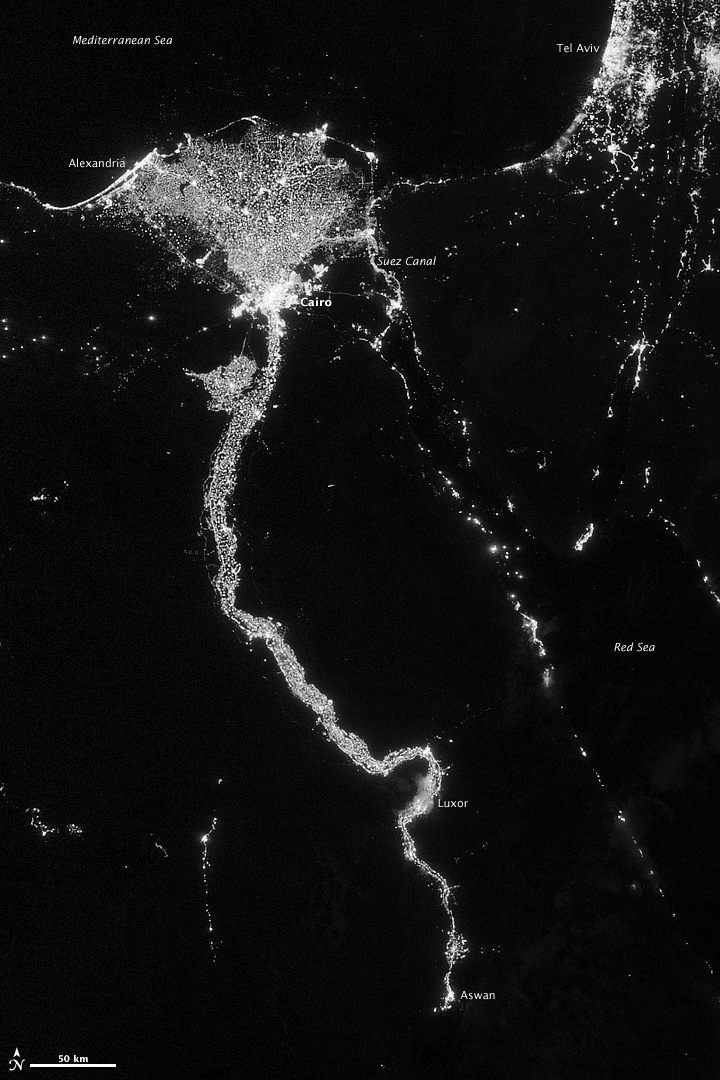 |
| Nile waters are central to Egyptian civilisation (NASA Earth Observatory 2012) |
Dr Megrabi pointed to floodplain growth, fertiliser use, and scouring of the river - as decreasing biodiversity and having very real consequences on downstream ecology, he called for studies specifically on the ecological impacts of the GERD that are presently misunderstood and therefore dangerous (Megrabi 2023). In Sudan, environmental changes caused by dam filling are already being observed, with farmers seeing reduced irrigation from lower water levels (Al Jazeera 2022).
Turning to the very region in which the GERD was built, the Benishangul-Gumuz region of Ethiopia, we see vulnerability to increasing temperatures and inadequate rainfall, causing food and water scarcity (Morka & Tesfaye 2018). While Egypt's food and energy needs rely on upstream water availability (Pemunta et al 2020), therefore, human security issues are inextricably linked between upstream and downstream states, making collaborative management of the Nile's waters a necessary framework. However, pressures like this have previously served to increase fragmentation (Homer-Dixon 1994). Tensions have grown so much in the region, to drive Ethiopia to install an Israeli defence system at the GERD, much to Egypt's protest (Zaher 2019).
We hope that a framework can be developed to collaborate on managing the Nile's resources that is more encompassing than the CFA has been so far. Danburam and Briollais (2022) put forward an optimistic argument for fostering cooperation between Egypt, Sudan, and Ethiopia. This uses the GERD as a platform for active cooperation. Intense collaboration and benefit sharing would see Egypt building its infrastructure to increase water efficiency, Sudan its irrigation, and Ethiopia its energy exports, to provide active solutions to the human security threats detailed in the above paragraph (Tesfay 2020). This cooperative framework would bring the ideal management for the inevitable climate-change-induced droughts. To achieve this, the Nile Basin Initiative would need Egypt to re-join, and the collaborative approaches of the CFA to be reconsidered by the downstream states.
Next time I will be looking at the historical context of Nile hydro politics, before investigating the hope for a collaborative future in depth.


Comments
Post a Comment